
2025 Dietary Guidelines Reviewed by a Root-Cause Doctor

If you’ve been online lately, you’ve probably seen it: the new 2025 food pyramid. It’s making waves across social media, healthcare circles, and probably your family group chat. Pretty soon, it’ll be haunting my dreams. Some people love it, while others say it misses the mark. And many are wondering: is this really an improvement, or just more recycled diet advice?
As a naturopathic doctor who works with the root causes of chronic illness every day, I decided to take a closer look and a dive into the nutrition standards of other countries too, and what I found surprised me.
In this article, I’ll walk you through what’s actually changed in the 2025 pyramid, how it compares to past guidelines (and where it still misses the mark), what other countries are doing differently, and most importantly: how you can use this information to make better food decisions for your body.
Keep in mind that to develop the optimal diet for any one person, there are a lot of considerations. The most important are probably your metabolism, activity levels, and the presence of diseases like diabetes, ulcerative colitis, or autoimmunity, to name a few. There will probably never be one optimal diet for everyone, as the nuance is always needed depending on your unique needs. However, federal nutrition guidance can be a helpful and authoritative starting place.
Why the Food Pyramid Is Back in 2025
I was happy to see that the new leadership in the US Department of Health and Human Services (HHS) updated their nutrition recommendation guidelines, as I have been a critic of that department for years, given that America’s chronic disease statistics have only worsened over the course of my life. I talk about it more specifically in my first book, In Pursuit of Health, which takes a common-sense approach to the issue.
Moreover, I was excited when I watched some the press conference, because our leaders are finally talking about prioritizing root cause treatments for disease rather than pharmaceuticals. You may feel the same way as I do at this point: wow, finally. While updated food guidelines are helpful, the more important point is the shift away from symptom suppression and toward root causes and disease resolution.
Although it seems like the food pyramid has been an irrelevant concept since its introduction in 1992, you may not have realized that it was updated a few times since then. The most recent iteration was termed “MyPlate,” which outlined federal nutrition recommendations from 2011 until today.
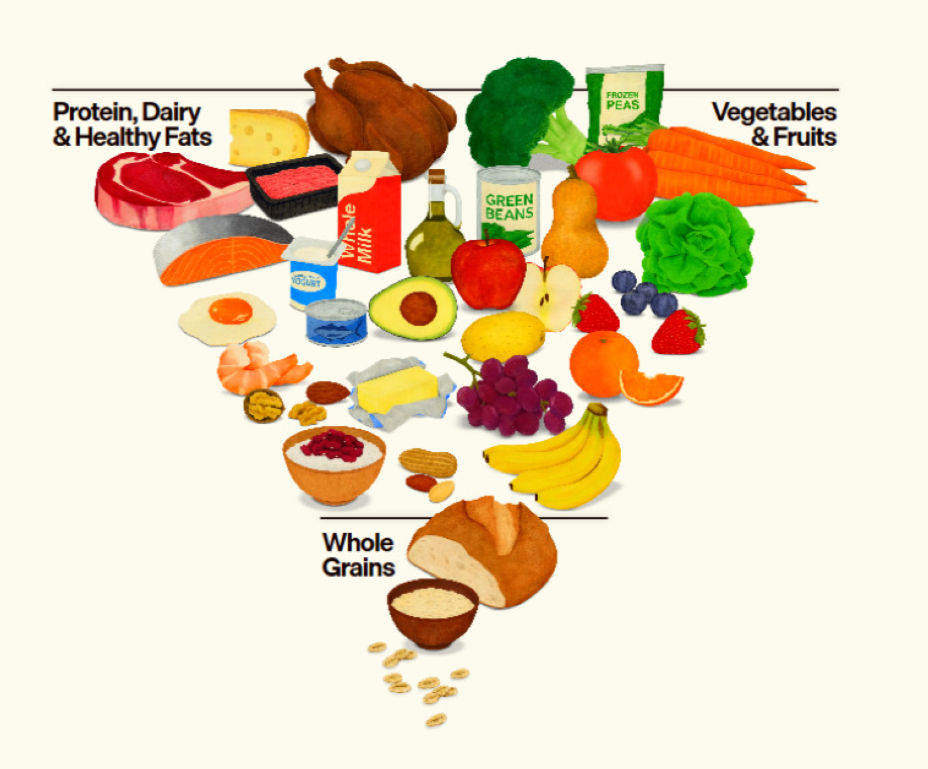
Between the first food pyramid and MyPlate was “MyPyramid,” which set federal nutrition recommendations from 2005 to 2011. After two pyramids, the concept was ditched for MyPlate. But . . . the pyramid is back! Let’s begin by reviewing the original food pyramid. If you missed it, below is the new food pyramid.
What the 1992 Food Pyramid Got Wrong

Remember the 1992 food pyramid? It had that space-like background. The visual is very 90s. I remember staring at those loaves of bread when I was a kid and thinking to myself, hm, that’s a lot of grains.
It recommended that adults eat between 6 and 11 servings of grains every day, which I think is rather difficult to accomplish. One serving is equivalent to about a slice of bread, half a cup of pasta, or half a cup of oatmeal.
Imagine eating 11 slices of bread every day, or worse . . . 5 and a half cups of oatmeal. Gasp! That sounds like something you’d do if you’re a bodybuilder or if you didn’t have any other food available to you. Obviously, the grain recommendations are neither realistic, nor desirable.
The 1992 food pyramid’s fruit and vegetable recommendations were fair: 3-5 servings of veggies and 2-4 servings of fruits. It also advocated for relatively limited portions of meat, dairy, legumes, and nuts.
“Fats, oils, and sweets” were recommended sparingly.
Aside from the obnoxious grain recommendations, the most contentious part of the pyramid proved to be the fat and oil restriction.
I suppose at the time it was believed that fats and oils were non-essential to health, and at times they were even accused of causing health problems, but I can’t say for sure because I was too young to remember.

I do remember the prevalence of margarine—particularly that ugly tan tub of Country Crock Margarine—which turned out to be a public health disaster and probably an embarrassment for the HHS. Crock of sh*t is more like it! It didn’t prove that fats were unhealthy, but only that it was unhealthy.
I think most Americans would agree that the 1992 pyramid missed the mark. Anyone who’s been curious about nutrition has probably learned more than one healthy approach to eating that differs from the 1992 food pyramid.
Through trial and error, people learned that eating proteins and fats is a pretty reliable way to lose weight, stabilize metabolism, and improve other health concerns. Savvy healthcare providers have known this long before the 2025 food pyramid recommended it. But the question is how many of those foods you should eat—a question that still remains unanswered.
Ultimately, the 1992 food pyramid was updated in 2005, and the concept was given a makeover.
What Was “MyPyramid” and Why Did It Fail?

You’ve got to love the name “MyPyramid.” It has a cozy, friendly, and more personable vibe. The image, however, depicts a rather unappetizing and cheap-looking display of food resting on the base of a colorful pyramid, no doubt a product of early 2000s Windows graphics.
Also, pictured adjacent to the pyramid is an individual on a set of steps, which was meant to convey the inclusion of moderate daily exercise.
The food group recommendations weren’t really on target with the principles of healthy eating, in my opinion. The emphasis was on grains and vegetables (27% and 23% respectively), and then dairy (23%). The rest was fruit (15%), protein (10%), and “oils” which included fish and nuts (2%). There was an additional emphasis on ensuring that half of the grains consumed were whole grains.
Basically, this was the era of low-fat everything, hence why there’s no actual fat category. And among the foods like dairy that naturally contained fat, it was advised to consume low-fat or fat-free options, which is the opposite of today’s 2025 dietary guidelines. Also, it was apparently a low-protein era as well.
What Is MyPlate and How Did It Replace the Food Pyramid?

In 2011, the USDA switched to a plate graphic, which is commonly used in other countries, sometimes in combination with a pyramid. And thus concluded the 6-year reign of MyPyramid.
MyPlate held the grain recommendation constant at 30%, but doubled vegetable (40%) and protein (20%) portions. It slightly decreased the fruit (10%) portion and also advised a couple servings of dairy.
There was no distinct recommendation for fats or oils, as the era of fat-free foods still ruled with an iron fist. Generally, the idea was to continue avoiding fat.
No real progress was made with the introduction of MyPlate in regards to disease statistics. The cardiometabolic disorders still climbed, which leaves you to wonder if it were all of these nutrition guidelines that led Americans toward chronic illness. Or was it something else?
As explained later in this article, the plummeting health of Americans has definitely been a result of cultural issues, not federal guidelines. Do you know anyone who's followed any of these federal dietary guidelines through the years? I don't, so there must be another reason why the chronic diseases skyrocketed.
What Are Federal Dietary Guidelines and Why Do They Matter?
Federal dietary guidelines in the US are developed by the US Department of Agriculture (USDA) and the HHS, and they’re meant to serve as a reference that provides nutrition information for general health. This nutrition guidance also occurs in other major countries, according to what their leadership believes is beneficial for the health of their citizens.
An important point to keep in mind is that the US population’s nutritional needs have changed over time, which has shaped nutritional guidelines. This is because we now realize that the many of the chronic illnesses that plague us are driven by dietary choices, whereas 100 years ago before food pyramids, illness was driven by poor hygiene, starvation, and acute infectious illnesses like tuberculosis.
As you may know, America’s health status is rather poor. The main diet-driven issues are the cardiometabolic disorders like diabetes, cardiovascular disease, obesity—so the nutrition recommendations consider the nutritional needs of myriad individuals living with these diseases.
The point of these updating these guidelines, as I see it, is to improve the health of the nation by taking into account current health challenges, disease statistics, and human behaviors. The idea is to reduce the rates of the most prevalent chronic illnesses, considering how dietary recommendations should shift to accomplish that.
Over time, it’s reasonable to assume that the guidelines might shift again, depending on how disease statistics change. For example, if mental health disorders begin to surpass cardiometabolic disorders, we might explore nutritional options that are protective for mental health, building on the metabolic recommendations.
What’s New in the 2025 Dietary Guidelines? A Naturopathic Doctor’s Perspective
The 2025 food pyramid is based on the concept of eating real food, and the nutritional emphasis is on proteins. Aside from proteins, staple food groups include vegetables, fruits, grains, and full-fat dairy.

There is no emphasis on fat or meat despite what people are saying. It's just that for the firs time ever, the guidelines specifically recommend consuming healthy fats.
Generally, as I explain below, fat is recommended to be incorporated in your diet. But the emphasis is on eating whole foods.
Clear and specific advice directs Americans to avoid junk food. The main message is to avoid fast food, processed foods, refined carbohydrates, and added sugars.
Assuming that you currently eat a standard American diet, I’m confident that if you only ate whole food and paid no attention to how much of each food group you ate, you’d probably improve your health. Humans need to eat real food every day.
What to Eat According to the 2025 Dietary Guidelines: Macronutrients & Food Groups
The number of recommended servings for each food group is based on a 2000-calorie diet, but one of the first headings notes that the ideal number of calories depends on your age, sex, body mass, and activity level. This is a key point that speaks to the importance of individualized nutrition.
It would benefit you to figure out how many calories you require on a daily basis. Here is a simple calculator that you can use.
For a 2000-calorie diet, below are the given recommendations for each food group.
How Much Protein Do You Really Need?
The recommendation is to eat 1.2 - 1.6 grams per kilogram of body weight. Again, there is no emphasis on meat, as many people have erroneously concluded based solely on the image of the pyramid showing red meat and poultry at the top.
The guidelines specifically states that people should consume a “variety of protein foods from animal sources [. . .] and plant-sourced proteins.”
The idea is only to “prioritize protein foods at every meal” as is clearly stated in the Dietary Guidelines for Americans document. Critics argue that Americans currently get enough protein and that the emphasis on protein is inappropriate advice, but I disagree.
You have to bear in mind the big picture. The goal is to reduce the diet-driven cardiometabolic diseases, which the government has officially admitted was caused by the overconsumption of processed foods, added sugars, and refined carbohydrates. Americans have mostly been eating these foods.
Long-story short, people haven’t ever been following any federal guidelines. People are not even eating real food! We need a baby step . . .
Prioritizing proteins gives people something solid to focus on and doesn't pose much of a health risk for the average person even if they've overconsumed them. It's good advice if we're working to reduce cardiometabolic diseases.
What Fats Are Actually Recommended?
The guidelines state that more research is needed to determine which types of fats support long-term health. But it says to incorporate “healthy fats,” and the examples given are meats, poultry, eggs, omega-3 rich seafood, nuts, seeds, full-fat dairy, olives, avocadoes, olive oil, butter, and beef tallow.
There is no specific recommendation given regarding how much fat you should eat, however, saturated fat is noted as an area of caution. It advises that you limit your consumption of saturated fat to 10% of your total daily calories. That would be 200 calories for a 2000 calorie diet.
To give you an idea of how small that is, it equates to roughly 2 tablespoons of butter or 2 ounces of cheese every day.
Keep in mind that saturated fats come from animal products, and unsaturated fats come from plants.
According to the 2025 dietary guidelines, limit saturated fats to less than 200 calories per day if you’re following a 2000-calorie diet. When it comes to unsaturated fats, eat them, but the optimal amount is unknown at this time.
I did some number crunching and discovered that this section conflicts with the dairy recommendations, which advocate for 3 servings of full-fat dairy (saturated fat) per day. If you ate all 3 servings, it would equate to roughly 15% of total calories from saturated fat. Examples of one dairy serving would be either 1 cup of yogurt, 1.5 ounces of cheese, or 1 tablespoon of butter.
In reality, the recommendation for saturated fat is actually higher than stated, given that the dairy requirements start you around 15%. Eating the recommended meats, poultry, and eggs would introduce more saturated fat.
This puts you somewhere above 15% of your total calories from saturated fat. And if you consume any unsaturated fats, say 2 tablespoons each of olive oil and nut butter per day, that would result in basically another 15-20% of your daily calories from fat.
In total, following the 2025 food pyramid guidelines would realistically result in a daily intake of at least 30% of your calories from saturated and unsaturated fat combined. I think this is reasonable and healthy, but again, it’s a gray area.
The USDA and HHS are confused about how much fat and which types of fat humans should eat every day, as admitted by the architects of the pyramid. Though, it’s clear that refined carbohydrates, added sugars, and processed foods should be avoided . . . so start clearing out the cabinets!
Full-Fat Dairy Made the Cut
As previously mentioned, the recommendation is 3 servings per day. And yes, that’s right, low-fat is no longer recommended.
Dairy is not something I typically recommend for patients in my clinic. Usually, I’m advising that people stop consuming dairy because I've found that the elimination of dairy (and gluten) positively influences gastrointestinal and immune disorders, which I often treat. And patients thank me for suggesting the elimination of those foods!
The negative consequences of consuming both gluten and/or dairy should present themselves to you after eliminating both for a few weeks and then re-introducing them. This is called an elimination diet, and I recommend that you try it.
Fruits & Vegetables: Still Non-Negotiable
The 2025 dietary guidelines recommend 2 servings of fruits and 3 servings of vegetables every day. I think that recommendation is reasonable and easy to satisfy. You could eat one serving of vegetables with each meal, and snack on a couple pieces of fruit throughout the day, maybe with some nuts too. Sounds pretty doable, right?
To improve this recommendation, I’d encourage 3 or more servings of vegetables based on what I see in my practice, as the vegetable fiber can really help the gut microbiome flourish.
There is an additional note under the dairy section about the importance of consuming fermented foods, but no specific recommendations given.
I would encourage that 10% of your vegetables be fermented to improve the health of your gut microbiome.
Furthermore, the recommendation is to eat a colorful variety of fresh, frozen, dried, or canned sources (without added sugar).
Grains Are Still In, But Not Too Many
2-4 servings of exclusively whole grains are now in style, which differs from previous guidelines.
MyPlate recommended that at least half of your grains be whole, and a higher amount of calories came from grains. 2-4 servings is less than MyPlate and a far-cry from the original 6-11 servings.
My opinion is that the average person should eat somewhere between 2-3 servings of whole grains every day, mainly because the fiber benefits your microbiome. For example, oat fiber offers significant benefit for keystone probiotics in your gut, helping them produce more of the crucial fatty acids like butyrate that support gut health. The fiber boost from whole grains also packs your bowels with extra mass to help with regularity.
Do Americans Follow Dietary Guidelines?
The number one question I have around these updated guidelines is this: Will Americans follow them? I think the primary issue that has created diet-driven chronic illnesses has not really been confusion about what to eat.
While there’s plenty of conflicting information and ambiguity in the nutrition science world, people have always known the following: whole, real foods are healthier than processed foods, fast foods, and junk foods. But with this knowledge, people still choose unhealthy foods. That’s why I think the real issue we face is not the result of misinformation. It’s a cultural problem.
Consider that the American lifestyle is fast-paced and work-intensive. Healthy practices like home-cooked meals are sometimes a luxury, and the lifestyle many people live makes eating more about convenience than health.
Clinically, almost everyone I see who has diabetes, cardiovascular disease, or gastrointestinal issues is eating a diet heavy in processed foods and low in whole foods. They may also be eating out frequently and not getting enough fiber.
I recognize that not everyone has the ability to prepare cooked, whole-food meals on a daily basis for various reasons. I find that most often the reasons relate to how their lifestyle is structured.
Embracing the typical American lifestyle creates a precarious situation where health is neglected or seen as a problem to be solved rather than a practice. Health is something you cultivate through mindful behaviors and a constructive mindset. You have to build healthy practices into your lifestyle, preferably at the foundation of your lifestyle.
That’s exactly why I focus on psychology and lifestyle in my practice—the real root causes of symptoms. It’s the most efficient way to address chronic illnesses, most of which are either entirely created by psychology and lifestyle habits, or are being significantly influenced by both.

👉 If you're curious about the real root causes of disease, check out my downloadable guide to learn more.
The old paradigm that resulted in using drugs for problems created by lifestyle choices neglected the root causes of your symptoms. Incidentally, that paradigm has shifted according to statements made by FDA commissioner Martin Makary MD, MPH at the 2025 dietary guidelines press conference.
The focus of American healthcare is shifting from symptoms to root causes.
To summarize the primary issue as I see it: the 2025 dietary guidelines tell us to eat real food at every meal, but the struggle for most people is how to structure their lifestyle to make that possible. Usually, it requires re-thinking your day to day agenda and choosing to embrace health as a concept.
Is the New Food Pyramid Good or Bad?
As a root-cause doctor, I’m encouraged by the shift toward whole foods and away from processed junk. But several aspects still deserve scrutiny and clarification.
Red Meat & Eggs
While the new 2025 food pyramid does have some gray areas, particularly around dairy and fat, it does deliver a ruling on red meat and eggs.
Make sure to tell your dad, mom, uncles, aunts, and grandparents that they can enjoy red meat and eggs without guilt again! Personally, I enjoy eggs quite frequently, and red meat only occasionally. And no, my cholesterol is not too high.
Again, there is no emphasis on meat or red meat, but it’s considered an acceptable source of protein and fat.
Plant-Based Dieting & Environmental Concerns
One major criticism of the new 2025 food pyramid is that is doesn’t specifically advocate for a plant-based diet. Generally speaking, plant-based diets are considered to be the healthiest and most environmentally friendly.
I think these criticisms are valid, but remember that the guidelines take aim at the cardiometabolic diseases in a way that's appealing to Americans. On top of that, the guidelines are set to expire in 2030, so I’m assuming they'll be revised in 5 years.
For now, it’s probably best to focus on reducing the cardiometabolic diseases with this specific approach, and later re-working the pyramid to consider concepts like environmental impact.
Food Quality Concerns
Where does your food come from? Do you know? Most people don’t. But it’s important, because how your food was grown determines its nutritional value. Food grown using toxic chemicals like pesticides becomes toxic to you. Animals that were given antibiotics, hormones, and other undesirable compounds will affect your health in some way.
Naturally, if you had to choose between organic produce and produce grown using pesticides, with no difference in price, I’d bet that you’d choose organic every time. And likewise, if you knew that your food came from a local farm, you’d probably agree that the quality is better because it’s fresher. It’s common sense. But the 2025 food pyramid doesn’t mention food quality.
In the 2025 food pyramid, there’s no emphasis or note about food quality aside from eating real food.
There’s guidance about how to cook food, e.g. baked, broiled, roasted, but not about choosing foods that were grown according to healthier standards like organic and pasture-raised.
I can think of two reasons why this common-sense addition was omitted. Presumably, telling an entire nation of people to favor organic produce, wild-caught seafood, and pastured animals might financially devastate commercial farm operations that aren’t raising animals on pastures or growing crops without pesticides and insecticides. That’s number one.
Number two is that the focus of the 2025 food pyramid is on eating real foods. We’re starting with that goal, and I think that’s smart. Let’s focus on getting people to ditch the junk food, then we can talk more about food quality.
It's still paramount to consume meats raised humanely and according to the animal’s natural diet, as well as to consume organic produce and wild-caught fish.
How Do Other Countries Compare? A Global Look at Dietary Guidelines
Given my broad interest in international culture, I thought it would be helpful to include a brief overview of the national food guidelines for several other countries that consistently rank among the healthiest in the world.
The specific recommendations from various countries are developed from a more holistic perspective and strongly value environmental sustainability, which is partially why many recommend plant-centric diets.
Japan
Last revised in 2010, the “Japanese Food Guide” is depicted as a spinning top rather than a pyramid. Apparently, the spinning top is a popular toy among Japanese children, though it definitely needs a fresh design.
Like many Asian cultures, the Japanese recommend eating mostly grains and vegetables. But they favor meat and fish as well. It makes sense for them, given that rice, noodles, and fish are commonplace in Japanese cuisine.

Denmark

The Danish recommendations take a poster board approach that makes it relatively easy to estimate how much of each food group you should consume. From what I see, it looks like mostly fruits and vegetables are favored, followed by whole grains.
Legumes and fish are preferred over meat, while fats are given little attention. In fact, it specifically states to consume low-fat dairy and vegetable oils, which probably make up about 10% of the diet along with sweets. The emphasis is on plants, and the recommendations were last updated in 2021.
Switzerland

It’s probably one of my favorite countries, if only because of their integrative medical system and idyllic alpine villages (pictured here for your viewing pleasure).
I imagine the Swiss have a good handle on what should be eaten regularly, given that they enjoy excellent overall health.
Here’s what the Swiss leadership recommends, which resembles a plant-forward version of the 2025 US dietary guidelines. It also offers specificity around certain foods, and less protein.
Water: 1-2 liters
Vegetables: 3 servings
Fruits: 2 servings
Grains/Potatoes: 3 servings, at least half from whole grains
Dairy: 2-3 servings
Legumes, eggs, meat, fish: 1 serving
Nuts & Seeds: 1 small handful
Fats & Oils: specifically, 2 tbsp vegetable oil, 1 being from canola oil
Sweets/snacks: 0-1 serving

Italy
The Italian food pyramid is colloquially known as the Mediterranean diet, which I’m sure you’ve heard of. It was updated in 2025, and I like how the guidelines are split up into daily and weekly recommendations, although, there aren’t specifics given for grains and dairy/nuts.
The servings you see below for those categories are what I filled in based on the pyramid’s image.
Notably, you can see clearly that the emphasis is on fruits and vegetables.
Daily
Water: 1.5 – 2 L per day
Fruits & Vegetables: 5-8 servings
Whole grains: 1-2 servings
Olive oil: 2-3 servings
Dairy & nuts: 1-2 servings
Weekly
Seafood: at least 2 servings
Legumes: 2-3 servings
Poultry: 2-3 servings poultry
Eggs: 2 servings
Potatoes: 1-2 servings
Occasionally
Red meat and processed meat
Sweets
Wine

Additional Thoughts
It’s interesting to see how other countries approach nutrition. I only included four countries in this article, but I did research several more. What I found surprised me in some cases, because many countries seem to emphasize a diet focused on grains and vegetables, kind of like the 1992 food pyramid!
Countries like China, India, and Malaysia all consider grains to be foundational. In Mongolia, 11-16 servings of grains are recommended . . . daily! But make no mistake, all of these countries advise against junk food.
The 2025 food pyramid is embarrassing from an international perspective. The slogan “eat real food” leaves one to wonder what Americans have been eating besides real food. “Junk food,” right? I’m embarrassed that we’ve collectively reached a place where the government’s main piece of advice is to eat real food.
And, if you'll allow me to rant for a minute—why are the protein recommendations for the 2025 food pyramid given on the basis of bodyweight in kilograms? The accepted standard for bodyweight measurement in the United States is pounds.
I don’t understand why we don’t use the metric system in this country, but including it in these guidelines just adds confusion. We should either adopt the metric system or stick to imperial measurements. And while we’re at it, let’s ditch daylight savings too!
Future Considerations
As a forward-thinking person, I have many questions about how this new dietary guideline will impact the entirety of food in this country, from a public health, cultural, and socioeconomic perspective. I’d love to hear your comments and questions as well.
I imagine companies that produce processed foods are rather upset about these new guidelines, which specifically instruct people to avoid their products. How will they respond? American culture is laden with advertisements for junk foods presented by celebrities and other public figures who make it feel more socially acceptable to eat these foods.
Case in point: remember when former NYC mayor Bill DeBlasio shamelessly attempted to incentivize vaccination by eating a tray of fast-food from Shake Shack on live TV? The video is here if you missed it.
He told us all to get vaccinated so we could get a free burger and fries. I thought it was bizarre, and in the words of Chip Diamond, "unreal."
Generally speaking, I think the 2025 food pyramid is progress for America. It’s not perfect, but it addresses the cardiometabolic diseases and might help to reduce their prevalence—if people follow the guidelines.
Let’s talk about you next.

As a naturopathic physician, I believe that every person is unique—and so is their healing path. I take time to understand your story, lifestyle, emotional health, and physical health before making recommendations.
Whether I’m using nutrition, herbal medicine, homeopathy, or lifestyle counseling, my goal is always the same: to identify and treat the true cause of illness so your body can restore balance on its own.
If you’re interested in a personalized, natural approach to health, I invite you to join my newsletter for more insights.
You can book a 15-minute free consult right here or subscribe to my blog to get future updates on how to work with your body instead of against it.


